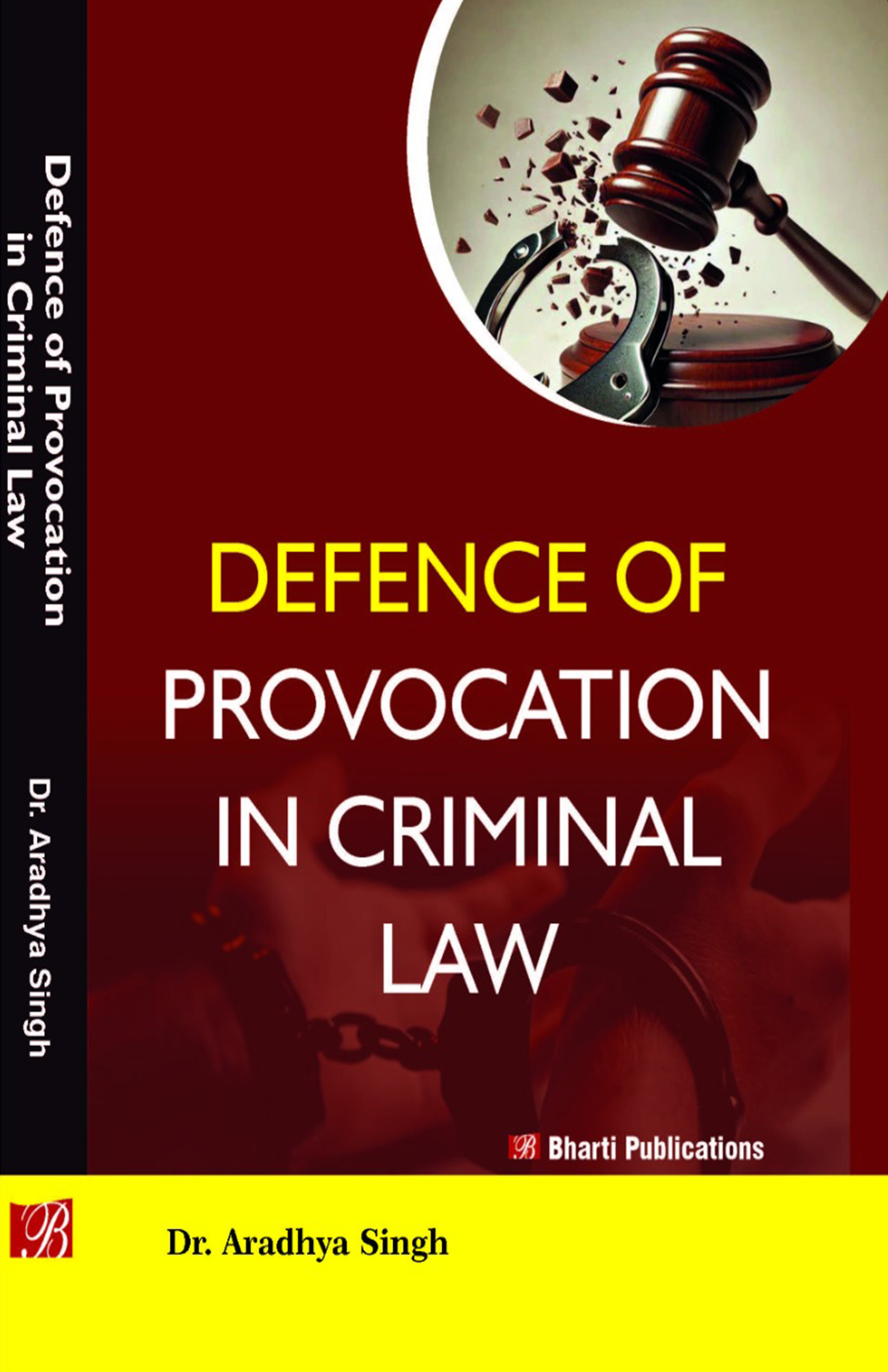

Defence of Provocation in Criminal Law is a comprehensive and scholarly exploration of one of the most debated doctrines in criminal jurisprudence. Built on a blend of historical evolution, theoretical analysis, and judicial interpretation, the book offers a complete and contemporary understanding of how the defence of provocation functions within the Indian legal system and across global jurisdictions. Recognizing that provocation lies at the intersection of law, psychology, morality, and social norms, this work examines not only the doctrinal foundations but also the human realities behind cases involving loss of self-control. It traces the defence from its common law roots to modern reforms such as the “loss of control” test in England, while also providing rich comparative analysis from Canada, Australia, the United States, and Asian jurisdictions. ... The book devotes special attention to the Indian position under Section 300 of the IPC, offering an in-depth exploration of landmark Supreme Court and High Court judgments. It also addresses contemporary issues such as gendered violence, honour-based claims, cultural provocations, and the growing criticism of patriarchal interpretations of “grave and sudden” provocation. With chapters on evidentiary standards, burden of proof, psychological insights, and procedural nuances, the work caters equally to practitioners, scholars, judges, and students. Written with clarity and academic rigor, this book serves as a vital reference for understanding how provocation is applied, challenged, and reformed in modern criminal law. It invites readers to reflect on broader questions of culpability, human behaviour, and justice asking not only what the law is, but what the law should be.
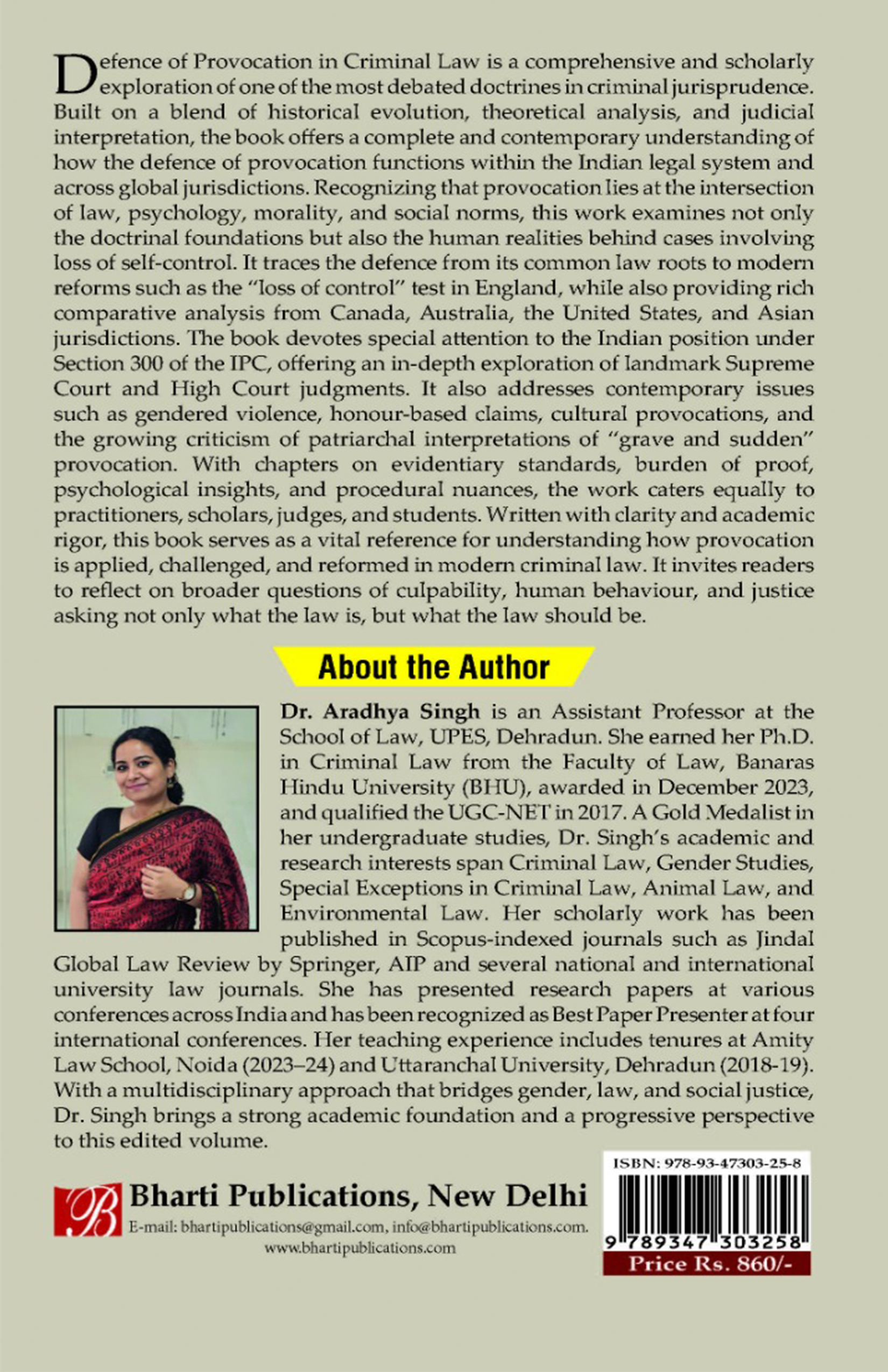
 Dr. Aradhya Singh is an Assistant Professor at the
School of Law, UPES, Dehradun. She earned her Ph.D.
in Criminal Law from the Faculty of Law, Banaras
Hindu University (BHU), awarded in December 2023,
and qualified the UGC-NET in 2017. A Gold Medalist in
her undergraduate studies, Dr. Singh’s academic and
research interests span Criminal Law, Gender Studies,
Special Exceptions in Criminal Law, Animal Law, and
Environmental Law. Her scholarly work has been
published in Scopus-indexed journals such as Jindal
Global Law Review by Springer, AIP and several national and international
university law journals. She has presented research papers at various
conferences across India and has been recognized as Best Paper Presenter at four
international conferences. Her teaching experience includes tenures at Amity
Law School, Noida (2023–24) and Uttaranchal University, Dehradun (2018-19).
With a multidisciplinary approach that bridges gender, law, and social justice,
Dr. Singh brings a strong academic foundation and a progressive perspective
to this edited volume.
Dr. Aradhya Singh is an Assistant Professor at the
School of Law, UPES, Dehradun. She earned her Ph.D.
in Criminal Law from the Faculty of Law, Banaras
Hindu University (BHU), awarded in December 2023,
and qualified the UGC-NET in 2017. A Gold Medalist in
her undergraduate studies, Dr. Singh’s academic and
research interests span Criminal Law, Gender Studies,
Special Exceptions in Criminal Law, Animal Law, and
Environmental Law. Her scholarly work has been
published in Scopus-indexed journals such as Jindal
Global Law Review by Springer, AIP and several national and international
university law journals. She has presented research papers at various
conferences across India and has been recognized as Best Paper Presenter at four
international conferences. Her teaching experience includes tenures at Amity
Law School, Noida (2023–24) and Uttaranchal University, Dehradun (2018-19).
With a multidisciplinary approach that bridges gender, law, and social justice,
Dr. Singh brings a strong academic foundation and a progressive perspective
to this edited volume.