
| S. No. | Title and Authors Name |
|---|---|
| 1 |
Unveiling Financial Shenanigans: Insights into Deceptive Practices and Regulatory Responses in Corporate India
Abstract
The paper explores ‘financial shenanigans’ in corporate India, encompassing
deceptive practices like revenue and expense manipulation, asset valuation
inflation, and off-balance-sheet transactions. It highlights notable fraud
cases such as Satyam and Kingfisher Airlines, underscoring regulatory
responses and reforms. Government initiatives like the Insolvency and
Bankruptcy Code and corporate governance reforms aim to enhance
transparency and investor protection. Despite these efforts, challenges
persist in regulatory oversight and enforcement. The study underscores the
need for robust controls, ethical conduct, and technological advancements
in financial analysis to mitigate fraud risks and uphold market integrity.
|
| 2 |
Implication of Artificial Intelligence on Banks’ Performance: A Review of Previous Research
Abstract
Artificial intelligence (AI) is transforming banking operations. As the
banking industry undergoes rapid digital transformation, AI-driven
technologies such as chatbots, automated loan processing, fraud detection,
and personalized customer services are reshaping operational efficiency
and customer experience. This paper aims to bridge the knowledge gap
by analysing the extent of AI adoption, its benefits, challenges, and the
effectiveness in the banking sector. Understanding these factors is crucial
for policymakers, banking professionals, and researchers to develop
strategic frameworks for AI integration, ensuring improved financial
services, security, and operational excellence. Additionally, the review of
earlier studies will provide insights into the impact of AI on employment,
decision-making, and customer satisfaction, thereby contributing to the
broader discourse on technology-driven banking reforms. Hence, the paper
is an attempt to review the promising literature in this emerging area
|
| 3 |
Trade Liberalization and Economic Growth in India: An Evaluation of Previous Research Studies
Abstract
Trade liberalization has been widely promoted as a strategy to stimulate
economic growth, yet its actual impact remains contested, particularly
in developing economies like India. Classical and neoclassical economic
theories emphasize the benefits of trade openness in enhancing
productivity, fostering foreign direct investment and facilitating
knowledge diffusion. However, empirical findings suggest that the
outcomes of trade liberalization vary significantly across countries and
sectors. Theoretically, trade liberalization enhances economic efficiency by
promoting competition, allowing resource allocation based on comparative
advantage, and facilitating technology transfer. In the Indian context,
trade liberalization gained prominence with the economic reforms of 1991,
which marked a shift from a protectionist, inward-looking economy to a
more market-driven, globally integrated economy. In the light of the above,
the paper is an attempt to analyze the earlier research studies on trade
liberalization and economic growth as well as on specific sectors of the
Indian economy covering pre and post economic reforms.
|
| 4 |
A Study on Ratio-Based Financial Performance of Indian Steel Industry: A Comparative Study Between Tata Steel and JSW Steel
Abstract
Financial analysis, encompassing financial ratio analysis and the
identification of strengths and weaknesses in the financial sector, plays
a crucial role in evaluating past managerial performance and predicting
future prospects. The study examines and interprets the financial analysis
of Tata Steel Limited (TSL) and JSW Steel. The report relies solely on
secondary data sourced from the company’s official website and financial
publications. The Balance Sheet, Profit and Loss Account, and Cash flow
statement have been employed to analyze and evaluate for interpretation.
Financial Ratios were used which helped in understanding the financial
health of the company. The ratios are the overall performance of a company
through which comparison tests can be made. For the completion of
the project report, liquidity ratios, solvency ratios, activity ratios, and
profitability ratios have been taken. It was found that the financial analysis
shows a good sign of improvement and growth from the past figures. It can
be ascertained that the companies will continue to grow and perform better
after understanding the financial statements and ratios.
|
| 5 |
Digitalization of Indian Banking Services in North East India: A Study on Post Graduate Students of Assam University Silchar
Abstract
This research investigates how postgraduate students at Assam University
have adopted, experienced, and challenged digital banking services
and, in doing so, recognizes the broader changing landscape of banking
services in North East India related to digitalization. Using a descriptive
design, primary data sources involved questionnaires with 400 students,
administered in an organized fashion. This study identifies what is
important for students to use digital banking services as well as key
satisfaction determinants, and challenges students experience as users
of banking services. The results indicate that usage of UPI (94.25%)
and mobile banking (74.25%) are the most prevalent samples of digital
banking services, with internet banking representing a smaller subset at
33.5%. Weekly usage rate far outpaced less frequent occurrences, and as
a whole, students reported they are mostly satisfied with convenience,
consistency, assurance, and security. Key determinant of usage was found
to be availability, access, convenience, and trust users have in the digital
banking systems. However, serious challenges the students experienced
include dependence on the internet (75.25%), absence of an in-person
user experience (63.75 earlier reference in- person), and connectivity
interruption (57.5%).The investigation of students experience of digital
banking services emphasizes the impact improved infrastructure and awareness could have in universities and rural communities. It suggests
also that education and awareness should be augmented to enhance
users’ experiences, notice and perform a more tailored service delivery,
and identify and repair the gaps in digital banking services delivered by
public/private banks. This investigation widens the scope of a developing
analysis in how digital or technology is aligned with the experience of
banking services for users, and could provide insight for improved policy
and technology options (particularly, a priority in North East and India
in general).
|
| 6 |
Problems and Prospects of Rural Entrepreneurship with Special Reference to Assam
Abstract
Growth of entrepreneurship plays essential role in economic growth of low-
income or developing economies by driving the structural transformation
from a traditional economy to a modern economy, creating new
enterprises, absorbing surplus labour from the agriculture sector and by
raising productivity and employment in both the modern and traditional
sectors. Empirics suggest that the vast majority of entrepreneurs in
developing countries are involved in micro and small enterprises. In the
North East India, the Government of Assam in early 1970 carried out a
small experiment on Entrepreneurship development. From the past few
years, the Government and various other different institutions exist to
facilitate the development of entrepreneurs in the region in setting up of
Small and Medium enterprise which provide assistance in various ways
like finance, technical, marketing, training. North East Council (NEC)
set up in the year 1972 carried out the significant role of entrepreneurship
in this region. It made a study on the entrepreneurial and managerial
needs of the region through SIET institute. Apart from NEC, now
there exist other institution and organization which works or function
for the promotion of Entrepreneurs. Assam has a lot to catch up in the
field of entrepreneurship. As per the India entrepreneurship report 2015,
only 22% of respondents in Assam felt that the business environment
in the state has improved significantly. Today, India is witnessing the emergence of the new age entrepreneurs in segments like Start Ups and
social enterprise. Start Ups in various sectors like food, health, education,
tourism etc. have been flooding the markets. But in Assam, the impact
of such new breed of business is yet to be felt. Except for a few handfuls
of young entrepreneurs who are trying to build a foothold in the Start
Ups segment, there is hardly any entrepreneurial activity in start-ups
and social entrepreneurship. Under the above perspective, this paper aims
to find out the obstacles in entrepreneurship development in Assam and
provide suggestions for remedial measures.
|
| 7 |
Issues and Challenges of Rural Entrepreneurs in Hailakandi District of Assam: A Case Study
Abstract
No doubt to say India is a country of 6, 49,481 of villages which are still
earning its livelihood depends on agriculture and its allied activities. Rural
entrepreneurs are also played an important role in the national economic
development, particularly in rural area. Rural entrepreneurship is not
only means of creating income, generating employment opportunities in
the rural areas with low capital cost and raising the rural income of the
people, but also its contribution to the development of agriculture and
rural industries. Rural development is a way of designed for improving
the economy and social life of the rural poor peoples. The valuable thoughts
of Mahatma Gandhi on rural entrepreneurs, “The future of India lies in
its villages”. Rural entrepreneurs are the backbone of the country. Rural
entrepreneurship can be considered one of the solutions to reduce poverty,
migration, economic disparity, unemployment and to develop rural areas
and backward regions. The main aim of the present paper is to find out the
several issues faced by the rural entrepreneurs as well as opportunities in
the district of Hailakandi of Assam.
|
| 8 |
Performance of Handloom Sector in India in recent years: An Empirical Survey based on Secondary Data
Abstract
The handloom sector holds a significant place in the Indian economy,
being one of the largest rural informal economic activities and providing
direct employment to over 6.5 million individuals involved in weaving
and related tasks. This study assesses the sector’s performance in
India from 2000-01 to 2020-21, focusing on sales, revenue, turnover,
and employment. Data has been primarily sourced from the National
Handloom Development Corporation (NHDC), Handloom Census
Reports, the Ministry of Textiles, and other government publications.
The analysis includes tabular and graphical representations. Considerable
inter-state differences in employment are observed, with states like Assam,
West Bengal, Tamil Nadu, Andhra Pradesh, and Odisha leading in the
number of persons engaged. However, recent trends indicate a downturn
in the sector, marked by declines in sales, turnover, exports, and overall
growth. This suggests stagnating demand for handloom products both
domestically and internationally, especially in the latter half of the last
decade. The COVID-19 pandemic has further worsened the situation.
Despite these setbacks, the sector possesses untapped potential for growth
and employment, particularly in the context of globalization and export-
driven development. The study concludes that understanding the precise reasons for this decline requires further in-depth, primary data-based research in handloom-intensive regions.
|
| 9 |
Inventory Management Practices of Hospitals with regard to Effective Service Delivery in Kamrup District of Assam
Abstract
Effective inventory management is crucial for any organization’s success.
It aligns with the corporate strategy and contributes significantly
to the value chain function. Increasing efficiency and effectiveness
enhances service delivery and provides a competitive edge in the highly
competitive market. Therefore, inventory management is vital in creating
a good service delivery for the organization. Since different service-based
companies use different inventory management systems, the objectives of
inventory management are to maintain inventory at the lowest possible
cost while adhering to target settings and securing a consistent supply of
resources to support operations. The present study examines the inventory
management practices currently followed by Government and Private
Hospitals for effective service delivery.
|
| 10 |
Digital Sustainability in E-Commerce: A Conceptual Review of Environmentally Responsible Practicesa
Abstract
In the face of growing environmental concerns, integrating sustainability
into the rapidly expanding e-commerce sector has become a pressing
necessity. This study explores the conceptual landscape of digital
sustainability in e-commerce by focusing on real-world practices, global
case studies, and policy-led innovations that promote environmentally
responsible digital operations. It highlights transformative initiatives
by major platforms such as Amazon, Alibaba, and Flipkart, along with
the pioneering efforts of green-tech start-ups like Brown Living and
Ecosia. Government programs such as Digital India and Start-up India
are also examined for their role in supporting eco-conscious digital
entrepreneurship. Despite these advancements, several challenges
persist, including high initial investment costs, low consumer awareness,
infrastructure limitations, and fragmented regulatory frameworks. The
study further outlines future directions, including the integration of ESG
principles, the development of sustainability certifications, the promotion
of green digital literacy, and support for climate-tech innovation.
Emphasizing the need for multi-stakeholder collaboration, the study
underscores that sustainable digital commerce is not only a strategic
priority but also a critical step toward achieving broader ecological and
economic resilience.
|
| 11 |
Creative Accounting: An Innovative Financial Strategy for Management
Abstract
Creative accounting, often described as the art of manipulating financial
statements within the boundaries of accounting standards, remains one
of the most controversial practices in the corporate world. While it is
frequently used to present an improved picture of a company’s financial
performance or position, it raises significant ethical and legal questions.
This paper explores the concept of creative accounting, shedding light on
the motivations behind its use with real-world examples of companies that
have employed creative accounting strategies, the techniques employed,
and the broader implications it has for stakeholders and the financial
ecosystem at large The ethical and legal aspects of creative accounting are
also discussed in this paper to deepen understanding of both its appeal and
its risks.
|
| 12 |
Assessing the Role of Unified Payment Interface (UPI) in Shaping Spending Patterns: Evidence from Gangtok City, Sikkim
Abstract
This study investigates the role of the Unified Payment Interface (UPI) in
influencing the spending habits of individuals in Gangtok City, Sikkim.
UPI, as a real-time payment system developed by the National Payments
Corporation of India (NPCI), has significantly transformed digital
transactions and consumer behaviour across India. The research adopts a
descriptive and analytical approach, using primary data collected through
a structured questionnaire from 252 respondents. Statistical analyses,
including regression and two-way ANOVA, were applied to examine
the relationships between UPI usage, spending habits, and moderating
variables like psychological and risk factors. The findings reveal that UPI
usage significantly affects spending behaviour, explaining 45.8% of the
variance in spending patterns. Gender, income, education, and age were
found to be relevant demographic influencers. While UPI usage had a
strong positive impact, psychological and risk factors did not significantly
moderate this relationship. The study contributes to the understanding
of digital financial behaviour in a semi-urban Indian context and offers
insights for policy formulation aimed at promoting financial inclusion and
responsible digital spending.rns Evidence from Gangtok City, Sikkim
|
| 13 |
Does Dividend Policy Differ? An Evidence from Selected Companies in India’s Oil and Gas Sector
Abstract
Dividend policy refers to the strategy a company uses to decide how much
of its earnings will be distributed to shareholders in the form of dividends.
This study examines the dividend policy practices of seven oil and gas
companies listed on the Bombay Stock Exchange. This study covers a
period of ten years (2015-16 to 2024-25) and attempts to study the dividend
policy and investigate whether there are any differences in dividend policies
among the selected companies. The study employs descriptive statistics
and Kruskal-Wallis Test to draw the inferences. The findings reveal that
the companies under study follow regular dividend policies but exhibit
different dividend payout patterns. The post hoc analysis indicates that
Reliance Industries follows a distinct dividend policy within the sector.
|
| 14 |
Role of Personality Traits in Entrepreneurial Success: A Comprehensive Study
Abstract
This study investigates the critical role of personality traits in shaping
entrepreneurial success, focusing on postgraduate students. Recognizing
that entrepreneurship is not solely influenced by external factors like
finance or policy framework, this paper explores internal psychological
traits that significantly contribute to entrepreneurial outcomes. Data have
been collected through a structured questionnaire from the post graduate
students of Assam University, Silchar. For the purpose of this paper 71
respondents have been selected through convenient sampling from the
department of Commerce and Business Administration. The study would
employ descriptive statistics, including mean and standard deviation, to
assess the perceived impact of specific traits. Key personality attributes
such as self-confidence, resilience, optimism, decision-making, creativity,
and leadership were analysed across domains including cognitive,
interpersonal, innovative, and managerial dimensions. The study would
highlight a strong correlation between positive personality traits and the
ability to innovate, adapt, and manage ventures successfully. Additionally,
it underlines the importance of educational institutions in nurturing these
traits through targeted training and curriculum.
|
| 15 |
A Comparative Study of Ethical Guidelines on Artificial Intelligence of Major Nations with India
Abstract
Artificial Intelligence (AI) is not only the buzz word of computer science
but it’s drawing attention from the entire science community. Scientists,
researchers, and institutions are merely pushing it to newer heights with
newer developments being introduced into already widening horizons.
Governments everywhere are also getting on board, creating space to
facilitate AI research and development to stay competitive in this rapidly
changing sector. As AI continues to grow, it’s becoming increasingly
integrated into sectors such as healthcare, finance, education, and the
defence and affecting not only businesses but also everyday life. With
this rapid rollout comes the pressing need for open legal guidelines,
policies, and standards to ensure AI is responsibly developed and utilized.
This chapter examines the status of regulations on AI in the European
Union (EU), the USA, the UK, Japan, China, and India with particular
emphasis on worldwide initiatives towards ethical, open, and responsible
AI systems. The EU has also led the way, creating an important precedent
by introducing the globe’s first holistic legal framework for AI, with risk-
based regulations for developers working in the region. USA, UK, Japan &
China have also contributed in making safe deployment and development
of AI Systems happen by guidelines and frameworks so that AI systems
adhere to ethical norms upon deployment but don’t legislate for the same
so that innovation as well as free speech can be promoted. India is set to witness a massive surge in AI development within its jurisdiction, yet
only highly limited ethical frameworks, advisory in type, are provided to
organizations to regulate the AI development within the state compared
to the enormous amounts of investments being put towards innovation
within the AI sector within the country.
|
| 16 |
Retailing in India in the 21st Century: Issues, Challenges and Prospects
Abstract
India is the most attractive retail market today with abundance of
opportunities. Retail has witnessed an immense growth in the last few
years. In India the vast middle class and its almost untapped retail industry
are the key attractive forces for global retail giants wanting to enter into
newer markets, which in turn help the Indian Retail Industry to grow
faster. There is no doubt that the Indian retail scene is booming. The key
factors responsible for the retail boom have been the change in consumer
profile and demographics, increase in the number of international brands
available in the Indian market. Today the organized players have attacked
every retail category. Indian retail industry though enjoys many unique
features is still in its nascent stage. Though large number of business
houses is coming forward to open up retail chains they will have to face
certain difficulties in bringing in excellence in their operations. Indian
retail industry/sector is facing different challenges at different levels and
functional areas. The Retail Industry in India has come forth as one of the
most dynamic and fast paced industries with several players entering the
market having immense potential in terms of opportunities. The issues
and challenges facing the Indian organized retail sector are stopping the
Indian retail industry from reaching up to its full potential. However,
in the recent past, Indian retail industry has witnessed several changes
due to increased per-capita income, changing life style, increased produc availability, a large young working population with median age of below
30 years, nuclear families in urban areas, along with increasing working
women population and emerging opportunities in the service sector. This
paper focused on major players in retail industry emerging challenge of
retail sector in India, future prospects of retail sector in India and findings
of the study.
|
| 17 |
Determinants of Financial Inclusion in Rural Households: A Study with Reference to Silcoorie Area of Cachar District, Assam
Abstract
This study explores the link between financial literacy (FL) and financial
inclusion (FI) among rural households in Silcoorie, Cachar district.
Using structured questionnaires, primary data was collected to evaluate
household-level FL and FI. The research examines how FL influences FI
while also considering additional barriers such as low income and limited
banking infrastructure. Regression analysis and other statistical methods
were applied to assess the impact of FL and demographic factors on FI.
The results indicate that FL is the strongest predictor of FI, whereas
factors like age, education, and income have minimal influence. However,
financial literacy alone does not ensure financial access due to persistent
structural challenges. The study emphasizes the need for a combined
strategy enhancing financial education while strengthening financial
infrastructure to achieve meaningful FI. Policymakers and financial
institutions should implement targeted FL initiatives alongside expanding
banking services and streamlining financial processes. Addressing both
knowledge and accessibility barriers will empower rural households and
improve their economic well-being. While focused on a specific region, this
study offers valuable insights for future research on financial inclusion
strategies in rural areas.
|
| 18 |
Labour Welfare Practices in Tea Industry: A Case Study of Hatticherra Tea Estate in Cachar District of Assam
Abstract
Millions of people worldwide consider tea to be the most preferred
beverage. Tea is one of the most widely consumed and affordable beverages
in India. Beyond its popularity, it is also a major agro-based industry
and one of the largest employers in the country, providing livelihood to a
significant number of workers directly. Over the past few decades, tea has
emerged as one of India’s most important commodities. To understand the
welfare conditions of tea workers, a survey was carried out at Hatticherra
Tea Estate, covering a sample of 212 labourers. The study aimed to assess
the availability and effectiveness of various welfare measures, while also
examining the roles played by management, government, and labour
unions in ensuring worker well-being. Particular focus was given to
health, safety, and welfare provisions, as these directly influence workers’
attentiveness, confidence, physical and emotional well-being, and overall
productivity. Primary data for the study was collected through structured
schedules and face-to-face interviews with the workers. Journals,
newspapers, various research reports, periodicals etc. acted as a potential
source for secondary data.
|
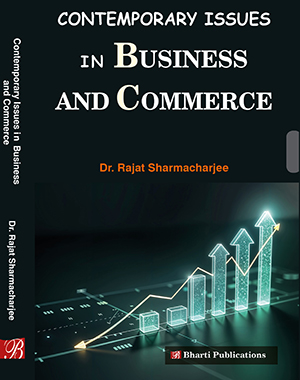
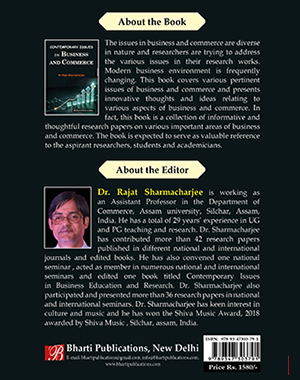
 Dr. Rajat Sharmacharjee is working as an Assistant Professor in the Department of Commerce, Assam university, Silchar, Assam, India. He has a total of 29 years’ experience in UG and PG teaching and research. Dr. Sharmacharjee has contributed more than 42 research papers published in different national and international journals and edited books. He has also convened one national seminar , acted as member in numerous national and international seminars and edited one book titled Contemporary Issues in Business Education and Research. Dr. Sharmacharjee also participated and presented more than 36 research papers in national and international seminars. Dr. Sharmacharjee has keen interest in culture and music and he has won the Shiva Music Award, 2018 awarded by Shiva Music , Silchar, assam, India.