
| S. No. | Title and Authors Name |
|---|---|
| 1 |
The Algorithmic Turn in Internationalization: How Artificial Intelligence and Platforms Reshape International Management
Abstract
The internationalization of firms is increasingly shaped by
digital technologies, algorithmic decision-making, and human-
centric principles, challenging the explanatory power of
classical internationalization models. This study introduces
the concept of the algorithmic turn in internationalization.
It develops an integrative framework encompassing three
complementary dimensions: AI-driven internationalization,
platform-orchestrated internationalization, and Industry
5.0 human-centric internationalization. Adopting a mixed-
methods research design, the study combines four in-depth
case studies with contrasting digital profiles and a survey of
218 internationalized firms to examine how these dimensions
reshape foreign market entry decisions, the configuration of
management accounting and control systems, and international
performance outcomes. The findings show that AI maturity accelerates international expansion and fosters hybrid entry
modes, that platform dependence entails a trade-off between
scale and managerial control, and that algorithmic and human-
centric governance mechanisms enhance the reliability and
adaptability of management accounting and control systems in
digitally mediated international contexts. The study contributes
to international management research by extending classical
internationalization theories to account for algorithmic and
platform-based dynamics, and by highlighting the role of
governance and control architectures in enabling responsible,
resilient, and human-centred digital internationalization
strategies.
|
| 2 |
Growth and Challenges of Unified Payment Interface
Abstract
The Unified Payment Interface(UPI) is a simple smartphone Interface
app which is emerged as the most transformative digital payment
innovations, enabling seamless, realtime fund transfers without any
bank details. It is launched by the National Payment Corporation
of India (NPCI) in the year 2016. It shows the massive growth not
only in value of the transactions but also the volume of transactions
over a period of 9 years due its enriched features like convenience,
interoperability, security and user friendly interface.. The study focus
on the understanding the theroetical concept of UPI, it highlights the
growth and milestone of UPI and examine the major challenges faced
by the user while using it. Even though its success at the peak level
it face the issues relating the the technical failure, security, digital
literacy gap, revenue sustainability and regulatory limitations. The
paper utilised the secondary data from the NPCI and RBI websites and
other published sources. The finding emphasis that there is need for the
rebust infrastucture, enhanced fraud preventions and greater digital
awareness to ensure the UPI’s continue growth and contribution to
the digital economy of India.
|
| 3 |
Pre and Post Glocalization of India: An Empirical Analysis
Abstract
It happened earlier but the rapid pace of globalization happened after
1870. The first stage of globalization happened from 1870 to 1914, second
from 1945 -1980 and third phase globalization has been continuing
since 1980. Globalisation has been instrumental in raising living
standards and has helped lift large parts of the world population out of
poverty. Trade openness has greatly enhanced productivity and vastly
improved consumption opportunities. Financial openness, in addition
to supporting international trade, allows greater scope for diversifying
risks and earning higher returns. It also makes funding more readily
available and facilitates the transfer of knowledge and know-how across
countries. Globalisation has also posed well-known challenges. Gains
from trade have not been evenly distributed at the national level. The
integration among the developed countries is much better than the
integration between developing countries. There is also asymmetry to
the growth of developed economies and developing economies. When developed economy and some select Asian economies have gained, the
entire1 African continent has been left behind. Domestic policies have
not always succeeded in addressing the concerns of those left behind.
The requisite structural adjustment has taken longer, and been less
complete, than expected. Furthermore, unless properly managed,
financial globalization can contribute to the risk of financial instability,
much like domestic financial liberalization has. And, not least through
financial instability, it can increase inequality. But globalization has
also often been made a scapegoat. For instance, there is ample evidence
that globalization has not been responsible for the majority of the
concurrent increase in within-country income inequality.
The paper highlight the concept of globalization from a historical
perspective. Working of the multilateral trade institutions and areas of
concern for the developing economies in the world are also highlighted
in this chapter. A special focus on world trade organization(WTO)
has been given. Focus has been provided on Impact of global trade
on economy and society has also been incorporated. Lastly, financial
instability has also been briefly explained in this chapter.
|
| 4 |
An Ancient HR Practices & Cross Comparison Relations in the Indian Industrial sector
Abstract
This paper addresses gaps in research related to study and understanding
of Human Resource Management in the context of Indian working
culture of industrial sector. HRM practices in India specifically in
the context of the industrial sector. The timeline industrialization in
India, growth of HRM and major transition across Indian industrial
sector post economic liberalization – 1991. Lacuna in communication
of goals, review of performance and use of key PA techniques like
Assessment Centers for objective analysis of multiple evaluation
parameters takes an initiative for betterment of the employees of the
organizations. Indian managers following a paternalistic way of
management find it difficult to adhere to the process of stringent and
objective performance appraisal systems. They generally tend to follow
an ad-hoc system of appraising performance which is more subjective,
and relationship oriented than objective and statistically measurable.
Their conflict in catering to their professional role while maintaining
balance with their social role in reflected in a superficial commitment to the process of performance appraisal and true value determination of the subordinates.
|
| 5 |
Cost of Cultivation and Returns of Brinjal by CACP Cost Concepts in Anand District: Way of Doubling the Farmers Income
Abstract
The doubling the income of farmers are possible by different ways, out
of all strategies of markets, which has increased the income of farmers
by using superior quality of seeds, high yielding varieties, use of drip
irrigation, recommended dozes for fertilizer and selling their produce
by proper marketing system. India is the second largest producer of
vegetables in the world next to China. Brinjal is the major vegetable crop
of middle Gujarat. The present investigation was carried out to study
the cost of cultivation and returns of brinjal by CACP cost concepts.
The study was conducted in Borasad and Anand which were selected
purposively and out of that 60 Brinjal growing farmers were selected
for the study. The decision regarding the choice of crop enterprise to
be taken on the farm and the allocation of area and resources under it
largely depends on level of yield, price of output and the cost of inputs
used in the production of that crop. The cost of cultivation and the
returns to different factors of production help in decision making about
the selection of crop and hence, these measures were worked out for
Brinjal. On an average, `. 91672.6 were spent on brinjal per hectare. Among the different components of cost of cultivation, hired human
labour accounted for the largest portion (21.73 per cent) followed by
the hired labour (11.38 per cent), value of FYM (9.34 per cent), value
of fertilizer (8.45 per cent), irrigation charges (7.85 per cent), rental
value of own land (5.54 per cent), insecticide and pesticide (5.10 per
cent), charges of machinery (4.91 per cent), seed (3.82 per cent) etc.,
for the cultivation of brinjal highest labour cost use for the picking
(54.90 per cent) followed by the irrigation (13.44 per cent), weeding
(12.32 per cent), transplanting (5.60 per cent), fertilizer application
(4.20 per cent), manure and cake (3.36 per cent) etc., Major problem
in cultivation of crop is farmers are not followed the recommended
package of practices and therefore they can’t get higher profit.
|
| 6 |
An Incidence of Financial Literacy in Anand District: A Critical Evaluation
Abstract
Financial literacy is essential for making informed decisions about
saving, investing, and managing personal finances. This study aims
to examine the financial knowledge, behaviour, and awareness of male
and female respondents and identify gender-based differences. There is
a significant relationship between the male and female regarding in the
financial ratio. Still the female is very lower than the male in financial
literacy. The results indicate that male respondents generally exhibit
higher financial literacy, including better understanding of interest,
inflation, savings, budgeting habits, investment practices, and
financial decision-making confidence. Female respondents showed
comparatively lower awareness and confidence, highlighting a gender
gap in financial literacy. The study emphasizes the importance of
targeted financial education programs, especially for women, to
improve financial knowledge, behaviour, and decision-making skills,
contributing to better personal financial management.40% is lacking in the financial literacy of female in the form of digital payment, bank
rate, financial decision making.
|
| 7 |
Urban Infrastructure: Problems and Solutions
Abstract
Urbanization is an index of transformation from traditional rural
economies to modern industrial activities. It is a long-term process.
This paper endeavors to illuminate problems and solutions of urban
infrastructure. India over a century with emphasis on level tempo of
urbanization and urban morphology using Indian Census data during
1901-2001. It will try to trace urban problems and related policy
issues. Now, India is among the countries of low level of urbanization.
Number of urban agglomeration /towns has grown from 1827 in 1901
to 5161 in 2001. Number of populations residing in urban areas has
increased from 2.58 crores in 1901 to 28.53 crores in 2001. Only 28%
of population was living in urban areas as per 2001 census. Over the
years there has been continuous concentration of population in class I
towns. On the contrary the concentration of. Population in medium
and small towns either fluctuated or declined. The graduation of
number of urban centers from lower population size categories to class
I cities has resulted top heavy structure of urban population in India.
India’s urbanization is often termed as over urbanization, pseudo-
urbanization. The big cities attained inordinately large population size
leading to virtual collapse in the urban services and followed by basic problems in the field of housing, slum, water, infrastructure, quality
of life etc. Urbanization is a product of demographic explosion and
poverty induced rural-urban migration. Urbanization is occurring not
due to urban pull but due to rural push. Globalization, liberalization,
privatization are addressing negative process for urbanization and
infrastructural issues.
|
| 8 |
From Household to Economy: the Case of Unpaid Women’s Work
Abstract
Unpaid and non-market activities performed by women, particularly
mothers, form a critical yet largely unrecognized component of
the economy. Despite their substantial contribution to household
maintenance, child care, health care, and social reproduction, these
activities remain excluded from conventional economic measurement
and national income accounting. This study examines the economic
relevance of women’s unpaid labour by drawing on field-based
observations and secondary evidence from some selected rural and
semi-urban areas of Odisha.
The paper highlights how mothers actively participate in various
socially essential but unpaid or underpaid activities, such as standing
in queues at Public Distribution System (PDS) centres, engaging
in manual labour under the Mahatma Gandhi National Rural
Employment Guarantee Act (MGNREGA), attending government
hospitals for reproductive health services, and managing household
responsibilities including child care and food security. Although these
activities do not generate direct monetary returns, they significantly support household welfare, labour market participation of other family
members, and the overall functioning of the economy.
Using a mixed-method approach, the study argues that the exclusion of
such non-economic activities from formal economic frameworks leads
to an underestimation of women’s contribution and reinforces gender
inequality. The paper emphasizes the need to reconceptualize economic
activity by incorporating unpaid labour into development planning
and policy design. Recognising and valuing women’s invisible work is
essential for achieving inclusive growth, gender equity, and sustainable
development.
|
| 9 |
The Cognitive Turn: Artificial Intelligence, Agentic Systems, and the Future of Digital Marketing
Abstract
The rapid evolution of Artificial Intelligence (AI) is transforming the
landscape of digital marketing, leading to what can be described as
a “cognitive turn” in marketing practice and strategy. This paper
explores the growing role of AI-driven technologies and agentic systems
in reshaping digital marketing processes, customer engagement,
and decision-making. The study examines how intelligent systems
capable of learning, reasoning, and autonomous action are enabling
marketers to move beyond traditional data analytics toward predictive,
adaptive, and personalized marketing approaches. Using a conceptual
and analytical approach based on recent literature, industry reports,
and emerging technological developments, the paper identifies
key shifts in marketing capabilities, including real-time customer
insights, hyper-personalization, automated campaign management,
and intelligent customer interaction through conversational agents
and recommendation systems. The findings suggest that agentic AI
systems are redefining the relationship between firms and consumers by enabling continuous learning from user behavior and optimizing
marketing strategies dynamically. However, the adoption of such
technologies also raises significant challenges related to data privacy,
algorithmic bias, ethical governance, and managerial control. The
paper contributes to the growing body of knowledge on AI-enabled
marketing by highlighting the strategic implications of cognitive
technologies and outlining a framework for understanding the future
trajectory of digital marketing. The study concludes that organizations
must integrate technological innovation with ethical responsibility and
strategic oversight to fully realize the potential of AI-driven marketing
ecosystems.
|
| 10 |
The Engaged Edge: Employee Commitment as a Driver of Financial Growth in India’s Private Banking Sectorr
Abstract
This provides compelling evidence that engaged employees contribute
meaningfully to improved financial performance, reinforcing the idea
that employee commitment serves as a powerful driver of tangible
organizational gains. Technological infrastructure, unnecessary
administrative burdens, or inefficient resource allocation. This indicates
that employee enthusiasm alone is insufficient, banks must ensure that
operational systems and workplace processes are streamlined, so that
the motivation generated through engagement can convert effectively
into higher productivity. The fact that employee engagement explains
54.2% of the variation in financial growth offers a persuasive data-
driven message for senior leadership, investing in engagement is not
merely an HR function or an operational expense, so it is a strategic
decision that generates a clear and quantifiable competitive advantage.
The correlation analysis reveals a distinct ranking among these
outcomes, with profitability showing the strongest connection to
employee engagement. This pattern suggests that as employees become
more committed and involved in their roles, the most immediate and
pronounced gains are reflected in an organization’s profit levels.
|
| 11 |
A Financial Analysis of Selected Dairies of Gujarat
Abstract
ndia has become the world’s largest milk producer. This is
accomplished by “operation flood” one of the largest creating a strong
connection between rural producers and urban consumers. The Indian
dairy sector contributes is Gross Domestic Product, which focuses on
the performance evaluation of the Gujarat State’s co-operative dairy
set programs in the world for milk production, to the agricultural
production of the industry engaged in milk and milk products
‘manufacturing and sales. Nine leading cooperative dairy units linked
to GEMME are chosen for these purposes. Information linked to all
nine-district cooperative dairy units for the last ten years were used
for evaluating the accomplishments of Gujarat dairy units. Collected
India is developing economy having agriculture as its primary
occupation of a considerably larger populace. Agriculture in India is
monsoon-dependent, while it gives employment to almost 50% of the
population, the farmers still live in portable situations. Poor and debt-
ridden farmers tend to commit suicides owing to them failing to adjust
to the challenges posed by man and mother nature. In such a situation,
making available to thema fitting alternative is vital for earning their bread and butter. Dairy facilitates thwarting such adverse conditions.
This research article makes efforts to highlight the dairy business as a
budding agriculture - sectoral.
|
| 12 |
Navigating the Forces : Impact of Internal and External Environment on Business Performance
Abstract
Business performance is shaped by a complex interaction between
internal organizational capabilities and external environmental
forces. We can see that markets are becoming more competitive,
so it is important to take care about monitoring and responding to
environmental variables – micro and macro. This research shows how
external factors such as competition, government regulations, socio-
cultural changes, technology, economic conditions and internal factors
such as leadership, organizational culture, human resources, financial
strength, and operational efficiency combined to enhance business
performance. The study is done with the use of a descriptive research
design, which is supported by a structured literature review and a
conceptual framework. Primary data is collected from 120 respondents
using a survey method representing MSMEs and medium-scale
enterprises. The analysis shows its outcome as internal environment
factors have a direct and immediate impact on performance, while external forces exert a moderate influence, often requiring
organizational adaptation. The study also offers recommendations
for improving internal processes, building resilience, and enhancing
strategic responsiveness to external conditions.
|
| 13 |
Business Development of Mutual Funds
Abstract
A common support is a plot in which a few individuals contribute their
cash for a common monetary cause. The collected cash contributes to
the capital advertise and the cash, which they earned, is separated
based on the number of units, which they hold. The common support
industry begun in India in a little way with the UTI Act making what
was viably a little reserve funds division inside the RBI. Over a period
of 25 a long time this developed decently effectively and gave financial
specialists a great return, and hence in 1989, as another coherent
step, open segment banks and monetary educate were permitted to
coast common reserves and their victory encouraged the government
to permit the private segment to attack into this zone. The points of
interest of shared finance are proficient administration, enhancement,
economies of scale, straightforwardness, and liquidity. The drawbacks
of common finance are tall costs, over-diversification, conceivable
assess results, and the failure of administration to ensure a prevalent
return. The greatest issues with shared reserves are their costs and
expenses it incorporates Buy expense, Recovery charge, Trade charge,
Administration charge, Account expense & Exchange Costs. There
are some loads which include to the fetched of common finance. Stack
is a sort of commission depending on the sort of reserves. Mutual reserves are simple to purchase and offer. You can either purchase
them specifically from the support company or through a third party.
Sometime recently contributing to any stores one ought to consider a
few figures like objective, chance, Finance Manager’s and plot track
record, Fetched figure etc. There are numerous, numerous sorts of
shared reserves. You can classify stores-based Structure (open-ended
& close-ended), Nature (value, obligation, adjusted), Speculation
objective (development, wage, cash advertise) etc. A code of conduct
and enlistment structure for shared support middle people, which
were in this way ordered by SEBI. In expansion, this year AMFI was
included in several improvements and upgrades to the administrative
framework.
The most critical drift in the shared support industry is the forceful
extension of the remote possessed common support companies and
the decrease of the companies drifted by nationalized banks and littler
private segment players. Reliance Shared Finance, UTI Common
Support, ICICI Prudential Shared Finance, HDFC Shared Finance
and Birla Sun Life Common Support are the best five shared finance
company in India. Reliance common subsidizing is considered to
be most dependable common reserves in India. Individuals need to
contribute in this institution since they know that this institution will
never disappoint them at any taken a toll. You ought to continuously
keep this into your intellect that if specific shared financing conspire
is on bigger scale at that point following time, you might not get the
same comes about so being a cautious financial specialist you ought to
take your major step constantly something else you will be incapable
to get the tall returns. This study explores the viability of the mutual
fund business in India, focusing on the structural evolution of the
industry from a government-led sector to a competitive private-market
landscape. The research analyses the operational mechanics of mutual
funds, including professional management, diversification benefits,
and cost structures (loads and management fees). By evaluating the
competitive standing of top Asset Management Companies (AMCs)
like Reliance, ICICI, and HDFC, the study emphasizes the importance
of performance metrics in guiding investor decisions. The findings
highlight that while mutual funds offer superior liquidity and
diversification, investor success depends heavily on transparency, cost
management, and a cautious approach to market volatility.
|
| 14 |
An Analytic Study of the Impact of Covid-19 on Financial Performance of Selected Pharmaceutical Companies in India
Abstract
This study investigates the critical role of personality traits in shaping
entrepreneurial success, focusing on postgraduate students. Recognizing
that entrepreneurship is not solely influenced by external factors like
finance or policy framework, this paper explores internal psychological
traits that significantly contribute to entrepreneurial outcomes. Data have
been collected through a structured questionnaire from the post graduate
students of Assam University, Silchar. For the purpose of this paper 71
respondents have been selected through convenient sampling from the
department of Commerce and Business Administration. The study would
employ descriptive statistics, including mean and standard deviation, to
assess the perceived impact of specific traits. Key personality attributes
such as self-confidence, resilience, optimism, decision-making, creativity,
and leadership were analysed across domains including cognitive,
interpersonal, innovative, and managerial dimensions. The study would
highlight a strong correlation between positive personality traits and the
ability to innovate, adapt, and manage ventures successfully. Additionally,
it underlines the importance of educational institutions in nurturing these
traits through targeted training and curriculum.
|
| 15 |
Fintech-Driven Financial Inclusion and Women’s Economic Empowerment: An Econometric Analysis from Gujarat
Abstract
The expansion of digital finance through fintech platforms has
played a significant role in promoting financial inclusion in India,
particularly among women. Despite substantial progress in access to
formal financial services, evidence on whether fintech-driven digital
finance translates into meaningful economic empowerment for women
remains limited. This study examines the relationship between digital
finance and women’s economic empowerment in Gujarat using an
econometric approach based exclusively on secondary data.
The study utilises data from nationally representative sources, including
the National Family Health Survey (NFHS-5) and publications of
the Reserve Bank of India (RBI), to construct indicators of digital
financial inclusion and women’s economic empowerment. Regression-
based econometric models are employed to analyse the association between digital finance indicators and empowerment outcomes, while
controlling for relevant socio-economic characteristics.
The findings indicate a positive and statistically significant
association between digital finance indicators and women’s economic
empowerment. However, the results also suggest that socio-economic
disparities and structural constraints continue to limit the extent of
empowerment gains. The study contributes to the empirical literature
on digital finance and gender inclusion and offers policy-relevant
insights for strengthening fintech-driven financial inclusion strategies
for women in Gujarat.
|
| 16 |
Benchmarking Credit Card Interest Rates Across Public and Provate Banks
Abstract
Credit card interest rate policy started by the Reserve Bank of India
to given short time credit to the customer to ensure their short time
financial needs. There are approximately 5-6% of the population are
using the credit card in India. While penetration is low compared to
countries like US, the numbers of active credit cards have surpassed
100 million, with significant growth rate in recent years. India’s credit
card penetration is estimated to be between 5% & 6% of the population.
However, public sector banks have the same interest rate over a decade.
Private banks demonstrate higher lending variability, whereas public
banks show relative stability. Significant positive correlation was
identified between the credit card interest rate of both types of banks.
This study highlights the increasing involvement of private sector
banks in credit card allotment, although public sector banks maintain
a predominant role. These findings suggests that future policies should
leverage the strengths of both types to build a more inclusive and
efficient credit card system in India.
Keywords: Reserve Bank of India (RB
|
| 17 |
Consumer Acceptance and Market Feasibility of Electric Vehicles in Vadodara City
Abstract
The transition toward sustainable and clean mobility has positioned
Electric Vehicles (EVs) as a viable alternative to conventional fuel-
based transportation. This study investigates the level of consumer
acceptance, awareness, and market feasibility of EVs in Vadodara City.
Based on a structured survey of 150 respondents, the findings reveal
that consumers show favourable attitudes toward EV adoption, driven
mainly by environmental concern, fuel cost savings, and technological
advancement. However, certain constraints such as inadequate
charging infrastructure, high battery replacement cost, limited driving
range, and uncertainty regarding resale value continue to restrict
wider adoption. The study concludes that while Vadodara demonstrates
strong market potential for EV penetration, strategic expansion of
charging networks, government incentives, and improved consumer
education are essential for accelerating EV adoption. The overall
outlook reflects a positive shift toward electric mobility, especially in
the two-wheeler segment
|

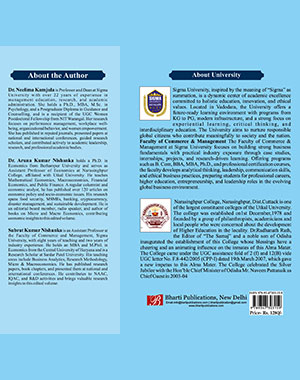
 Dr. Neelima Kamjula Dr. Neelima Kamjula, PDF, NIT-Warangal (UGCWM), Professor and
Dean of Faculty of Commerce and Management, Sigma University,
Vadodara, Gujarat, serves as the lead editor of Business Transformation
in the Digital and Algorithmic Era: Multidisciplinary Perspectives on
Finance, Sustainability, and Management. The book features chapters covering Artificial Intelligence, FinTech,
Financial Systems, Human Resource Practices, and Sustainable
Development. In addition to contributions the Faculty of Commerce
and Management, Sigma University, from esteemed universities across
Vadodara, Gujarat, Orissa, and Karnataka, a collaborative effort also
includes scholarly inputs from the University of Beira Interior, Portugal,
reflecting a truly global and multidisciplinary perspective.
Dr. Neelima Kamjula Dr. Neelima Kamjula, PDF, NIT-Warangal (UGCWM), Professor and
Dean of Faculty of Commerce and Management, Sigma University,
Vadodara, Gujarat, serves as the lead editor of Business Transformation
in the Digital and Algorithmic Era: Multidisciplinary Perspectives on
Finance, Sustainability, and Management. The book features chapters covering Artificial Intelligence, FinTech,
Financial Systems, Human Resource Practices, and Sustainable
Development. In addition to contributions the Faculty of Commerce
and Management, Sigma University, from esteemed universities across
Vadodara, Gujarat, Orissa, and Karnataka, a collaborative effort also
includes scholarly inputs from the University of Beira Interior, Portugal,
reflecting a truly global and multidisciplinary perspective. Dr. Arun Kumar Nishanka Dr. Aruna Kumar Nishanka holds a Ph.D. in Economics from Berhampur
University and currently serves as Assistant Professor of Economics
at Narasinghpur College, Cuttack, affiliated with Utkal University,
Bhubaneswar. He teaches Mathematical Economics, Macroeconomics,
Financial Economics, and Public Finance. He is a regular columnist and economic analyst, having published
more than 120 articles in local and English newspapers on economic
policies and their socio-economic implications. Dr. Nishanka is also
a member of the Editorial Board of the Journal of Research Innovation
and Management Science (JRIM) with an IIJF impact factor of 2.75.
His research interests include food security, tribal banking systems,
water resource management, cryptocurrency markets, medical tourism,
Islamic banking, cyber security and insurance, disaster management, and
MSME development. He has published several research papers and book
chapters in reputed journals and edited volumes.
Dr. Arun Kumar Nishanka Dr. Aruna Kumar Nishanka holds a Ph.D. in Economics from Berhampur
University and currently serves as Assistant Professor of Economics
at Narasinghpur College, Cuttack, affiliated with Utkal University,
Bhubaneswar. He teaches Mathematical Economics, Macroeconomics,
Financial Economics, and Public Finance. He is a regular columnist and economic analyst, having published
more than 120 articles in local and English newspapers on economic
policies and their socio-economic implications. Dr. Nishanka is also
a member of the Editorial Board of the Journal of Research Innovation
and Management Science (JRIM) with an IIJF impact factor of 2.75.
His research interests include food security, tribal banking systems,
water resource management, cryptocurrency markets, medical tourism,
Islamic banking, cyber security and insurance, disaster management, and
MSME development. He has published several research papers and book
chapters in reputed journals and edited volumes. Subrat Kumar Nishanka Subrat Kumar Nishanka, MBA, M.Phil. in Economics at Central University
of Haryana works as Assistant Professor in Faculty of Commerce and
Management, Sigma University with Eight years of teaching and two
years of industry experience. He is the Research scholar of Department
of Economics, Sardar Patel University, Anand, Gujarat. He teaches undergraduate and postgraduate courses including Business
Analytics, Research methodology, Micro and Macroeconomics as a
core subjects. He actively involves in academic planning, assignment
evaluation, Comprehensive project and student mentoring. In addition
to teaching, he contributes to institutional development through NAAC
and IQAC, R&D cell duties pertaining to the institute. He is committed to
research-oriented teaching, academic excellence, and bridging theoretical
knowledge with practical financial analysis.
Subrat Kumar Nishanka Subrat Kumar Nishanka, MBA, M.Phil. in Economics at Central University
of Haryana works as Assistant Professor in Faculty of Commerce and
Management, Sigma University with Eight years of teaching and two
years of industry experience. He is the Research scholar of Department
of Economics, Sardar Patel University, Anand, Gujarat. He teaches undergraduate and postgraduate courses including Business
Analytics, Research methodology, Micro and Macroeconomics as a
core subjects. He actively involves in academic planning, assignment
evaluation, Comprehensive project and student mentoring. In addition
to teaching, he contributes to institutional development through NAAC
and IQAC, R&D cell duties pertaining to the institute. He is committed to
research-oriented teaching, academic excellence, and bridging theoretical
knowledge with practical financial analysis.